
AI Can Fake the Image. So Apple Started Signing Reality.
AI image detection is a cat-and-mouse game. Apple takes a different approach: cryptographically signing camera captures so their origin can be verified instead of guessed.

Apple Is Signing Photos at the Sensor. That Changes the AI Image Problem.
Someone sends you a photo.
It looks real. But that doesn't mean much anymore.
You could upload it to an AI detector. Maybe the detector says 80% human-made. Another detector gives you 45%. Six months later, a newer image model produces pictures without the artifacts either detector was looking for.
There is a more interesting question we could ask:
What if the camera could prove that it took the photo?
That's roughly what Apple is trying to do with Reference Image.
It doesn't solve fake images. It doesn't detect every AI-generated picture. And, somewhat awkwardly, an Android user currently can't verify one in the same way an Apple user can.
But the architecture behind it is worth understanding.
Because Apple moved the problem somewhere else entirely.
The unusual part happens before iOS gets the image
When a camera takes a picture, light hits the image sensor and gets converted into digital data.
Apple establishes cryptographic trust around that point.
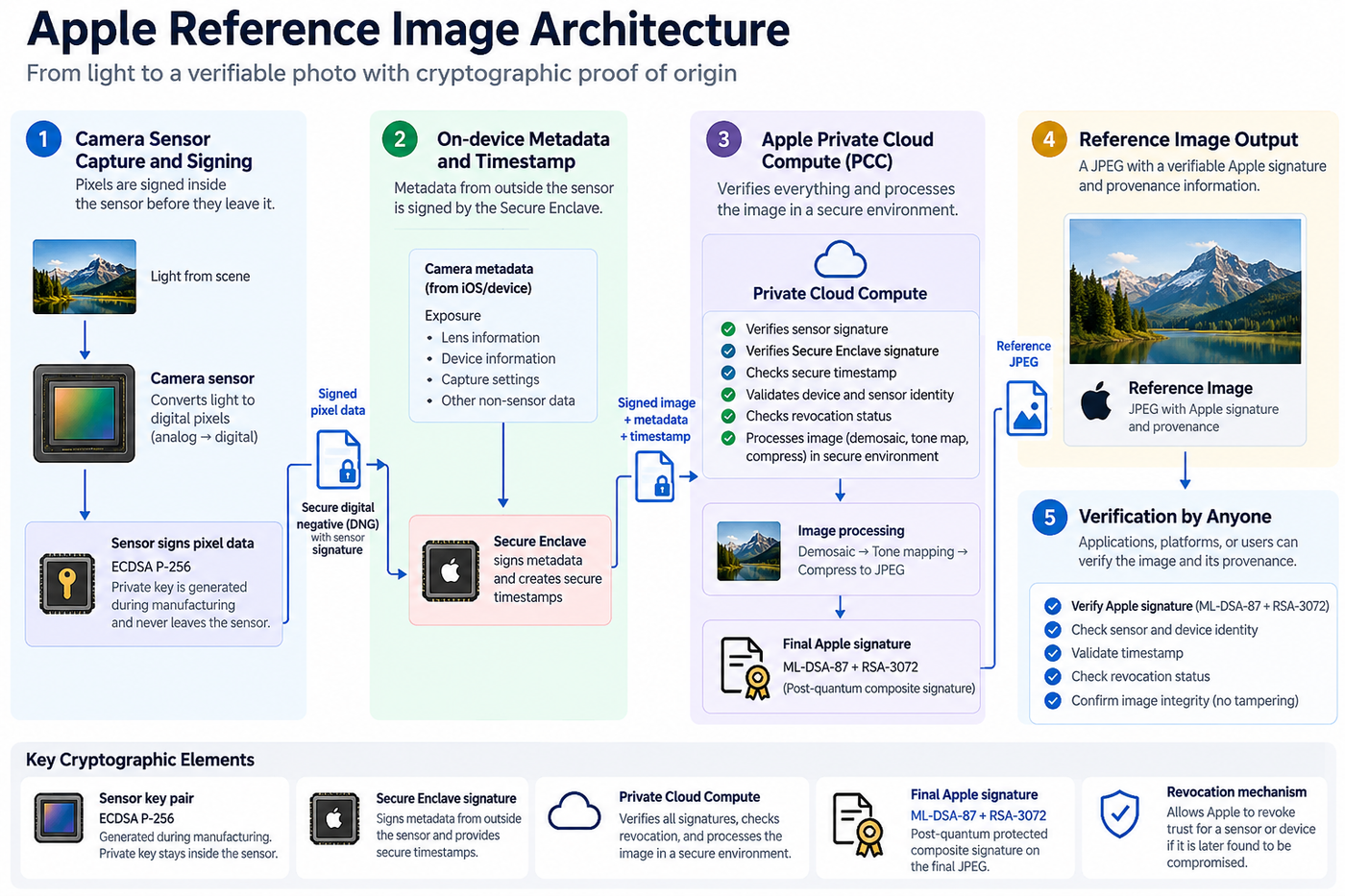
The camera sensor has protected signing capability. In Reference mode, captured pixel data is cryptographically signed before going through the normal software image-processing pipeline.
That's an important detail.
Apple could have taken the easier route: process the photo, produce a JPEG and sign the JPEG.
But then you're proving that some software signed a JPEG.
You're not getting nearly as close to proving where the pixels originated.
Instead, the chain starts roughly here:
Physical scene → Light → Sensor → Pixel data → Signature
The distinction sounds small until you think about what it means for the trust boundary.
The closer signing happens to the source, the fewer things you need to trust before the signature exists.
Except the signed pixels aren't the photo you eventually see
This is where it gets messy.
An iPhone photo is heavily processed.
Raw sensor information goes through demosaicing, color processing, noise reduction, lens correction, tone mapping and compression, among other operations.
So Apple has just cryptographically signed some data and then immediately created a system that needs to change that data.
The obvious question is: what exactly are we verifying then?
Not identical pixels.
The useful thing being preserved is their history.
Additional capture information is protected using trusted components including the Secure Enclave. Secure timing information helps establish when the capture happened. Apple essentially creates a protected digital negative containing the capture and evidence about its origin.
That can then go through Private Cloud Compute, where the relevant signatures, device information, timing and trust status are checked before the Reference Image is developed.
A simplified version looks like this:
Camera sensor
↓ signs capture
Protected digital negative
↓ verifies identity + metadata + time
Private Cloud Compute
↓ develops image
Signed Reference Image
So the JPEG can be different from the original sensor data while still having a cryptographic path back to it.
That's the clever bit.
Apple isn't trying to freeze the pixels.
It's trying to preserve their provenance.
Now send that photo to someone
This is probably the easiest way to understand why any of this matters.
Take a Reference Image and send it, with the Reference Image information included, to someone with a supported Apple device.
They can open the Reference Image and the system can verify the cryptographic evidence associated with it.
The recipient doesn't need another AI model to inspect the picture and guess whether it looks generated.
There is evidence from the capture itself.
And if the normal photo was edited later, the authenticated Reference Image gives the recipient something useful to compare it with.
That's substantially different from AI detection.
A detector examines an unknown artifact and asks:
"What probably created this?"
Reference Image starts at creation and later asks:
"Does the evidence from that capture still verify?"
Those sound like variations of the same problem. They're really not.
Here's where it breaks
Generate a fake photograph with an AI model.
Put it full-screen on a very good monitor.
Now point an iPhone at the monitor and capture it using Reference mode.
What happens?
Real light left the display.
A real camera sensor measured it.
The sensor legitimately signed what it captured.
The cryptographic chain can be perfectly valid.
And the event shown in the photograph still never happened.
This is why saying Reference Image proves that a photo is "real" goes too far.
It proves something narrower.
The camera genuinely captured what was physically in front of it.
Whether what was in front of the camera was truthful is a completely different problem.
A staged scene has the same issue. So does photographing a fake document.
Cryptography can prove provenance. It cannot prove reality.
That limitation isn't a failure of Apple's architecture. It's simply the boundary of what the architecture can actually know.
And knowing that boundary is important.
There is another slightly uncomfortable limitation
Send the Reference Image to another supported Apple device and there is a verification experience for it.
Send it to an Android user and things get less useful.
Android does not currently provide Apple's native Reference Image verification experience.
That matters more than it first appears.
Imagine this technology being used for an insurance claim, news photograph or some other situation where the recipient actually cares about provenance.
Saying "this is cryptographically verifiable, but you need a particular vendor's ecosystem to conveniently verify it" isn't an ideal end state.
The cryptography may be sound. The architecture may be clever. But trust becomes far more useful when the verifier doesn't have to belong to the same ecosystem as the creator.
If this idea goes anywhere beyond Apple devices, cross-platform verification will matter.
Possibly more than the camera feature itself.
One more detail is worth mentioning
What happens if somebody eventually compromises one of these trusted sensors?
Apple has thought about that too.
The system includes revocation.
A component that can no longer be trusted doesn't have to remain trusted indefinitely.
That gives the system something many architecture diagrams conveniently forget:
a way out.
We spend a lot of time designing how systems establish trust.
Production systems also need to know how trust ends.
The final Reference Image also uses a composite cryptographic signature involving RSA-3072 and ML-DSA-87, bringing post-quantum cryptography into the picture.
For ordinary holiday photos that sounds excessive.
For a photograph that might become legal evidence or remain part of a historical archive for 30 years, it sounds considerably less excessive.
The part worth borrowing
There is a temptation to look at this as an Apple camera feature.
The architecture is more interesting if the camera is removed.
What remains is:
Trusted source → signed data → controlled transformations → verifiable output
Consider a completely different system.
A factory sensor tells an AI agent that a machine is running at 147°C.
The agent doesn't have a reasoning problem. It understands 147°C perfectly well.
It has a provenance problem.
Did the sensor actually report 147?
Which sensor?
Did something alter the value between the sensor and the agent?
Was that device considered trustworthy when the measurement was taken?
Most enterprise AI architectures are currently concerned with getting more information into the model.
Sooner or later, some of them are going to have to worry much more about proving where that information came from.
And that may be the more interesting lesson from Apple's camera.
AI makes generating plausible information cheaper every year.
Trying to inspect every piece of information afterward and determine whether it looks genuine is one way to respond.
For some systems, there is another option:
Don't start by detecting the fake. Start by making the genuine verifiable.